Research Method 360: From Evidence to Impact
About Course
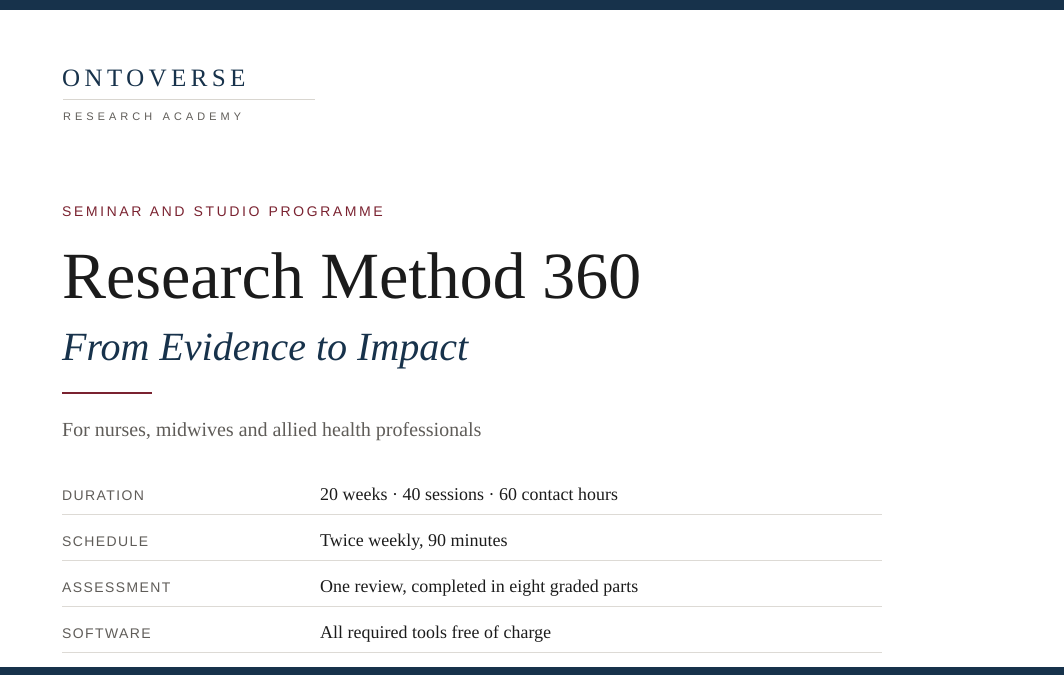
A seminar and studio programme for nurses, midwives and allied health
professionals who want to produce research, not only consume it.
Forty live sessions across twenty weeks, twice weekly, ninety minutes each. Every session is led by a reading. Every module feeds one accumulating piece of work — a completed review, built in eight graded parts, so that nothing is submitted at the end that was not made during the term.
You will leave having heard something about everything a researcher needs: paradigms and ways of knowing, searching and reference management, ethics and authorship, study design and sampling, quantitative and qualitative analysis, writing and peer review. And you will leave holding one thing you made yourself and can defend.
How this programme is taught
Constructivist, pragmatist and dialogic. Knowledge is built here, not transmitted. The
question decides the method — no paradigm is treated as superior. The seminar is a shared investigation: participants bring the cases, readings are argued rather than summarized, and the instructor’s own uncertainties are visible. Most people in this room have been positioned as consumers of research produced elsewhere. Naming that positioning is part of the curriculum, not a preface to it.
The eight modules
- Philosophy and Ways of Knowing — paradigms, pragmatism,
Carper’s patterns of knowing, and writing your own positionality statement. - Questions and Literature — practice gaps into researchable questions;
PICO, PICOT, PCC, SPIDER; PubMed, CINAHL, Scopus and Web of Science; MeSH and Boolean logic; Zotero and APA 7th; spotting predatory journals. - Ethics and Integrity — ERC, IRB and BMRC pathways; consent and data
protection; ICMJE authorship and how to negotiate it as a junior colleague; plagiarism, AI disclosure and reproducibility. - Review Methods — scoping, integrative, systematic, narrative and
rapid reviews; protocol writing and registration; screening in Rayyan; PRISMA-ScR and JBI; appraisal with JBI, CASP and MMAT. - Design, Sampling and Data Collection — quantitative, qualitative and
mixed-methods designs; sample size estimation; instrument validity, reliability and translation; KoboToolbox; open data such as DHS and MICS. - Analysis — reading numbers honestly; cleaning and codebooks;
descriptives through regression in jamovi and SPSS; thematic analysis in Taguette and NVivo; an orientation to R. Deep-dive electives for those who need them. - Writing and Publishing — IMRaD against the right reporting guideline;
results and discussion without spin; journal choice and indexing; submission, peer review and answering reviewers. - Symposium — you present your completed review to a panel, peer review
two colleagues, and revisit the positionality statement you wrote in week one.
Taught with specialists
Six sessions are led by invited experts — a research ethicist, a review methodologist, a psychometrician, a biostatistician, a journal editor, and a symposium panel. Each is briefed to show their own work, including what went wrong.
Three purpose tracks
Everyone completes the review. What differs is the additional weekly work, chosen in week two: Publish (a submission-ready manuscript), Apply (a doctoral or fellowship application package with a research proposal), or Build (a running journal club and a capacity plan for your institution).
What it costs you in time
Three contact hours a week plus three to five hours of independent work, for twenty teaching weeks. Reading before each session is required, not optional — a seminar without preparation is a lecture, and this is not a lecture course.
No software purchase required
Every required tool is free: Zotero, Rayyan, jamovi, Taguette, R, RStudio, OSF, KoboToolbox, OpenEpi. SPSS and NVivo are taught as an additional licensed lane for those whose institutions provide them. Nothing here requires you to buy or pirate software.
Who this is for
Nurses and midwives first — this programme was designed around their situation —
and open to all allied health professionals: physiotherapists, laboratory and radiography professionals, pharmacists, nutritionists, and public health and health-service staff. No prior research experience. No statistics background. A question from your own practice is the only real prerequisite, and it does not have to be well formed yet.
Course Content
L0 Digital Readiness Bootcamp
L1 Foundations of Health Research — the flagship
L2 Method Studios — choose one
L3 Publication & Peer Review Studio
L4 Fellowship & Teaching Pathway
Student Ratings & Reviews